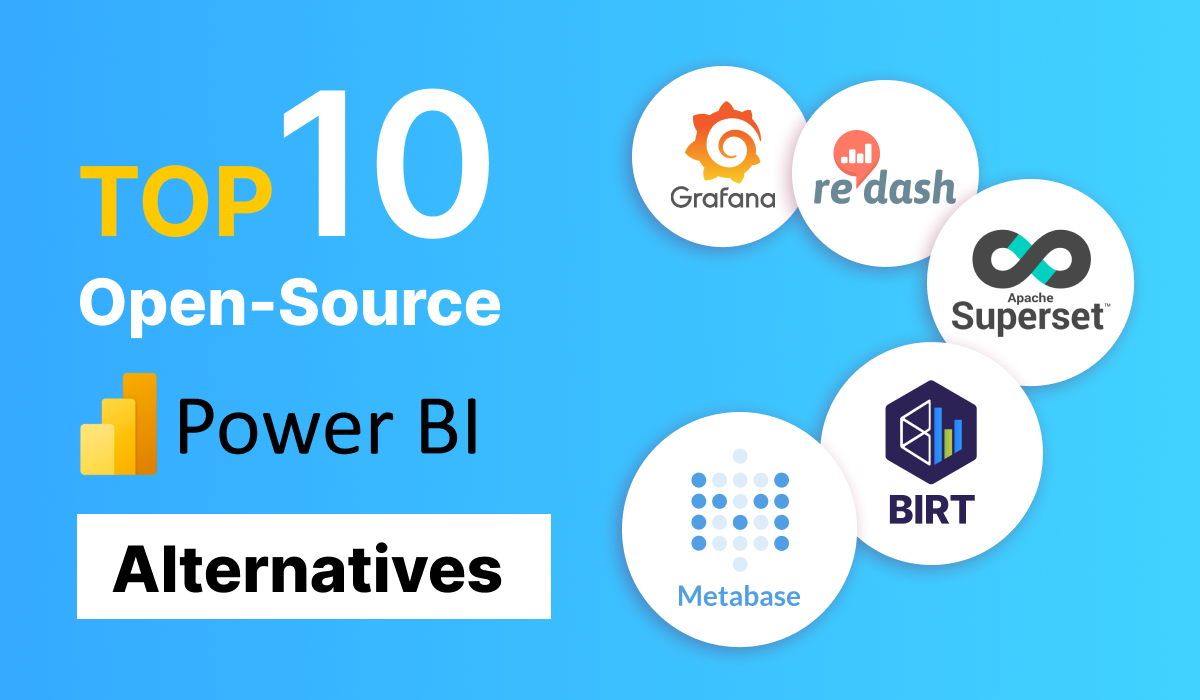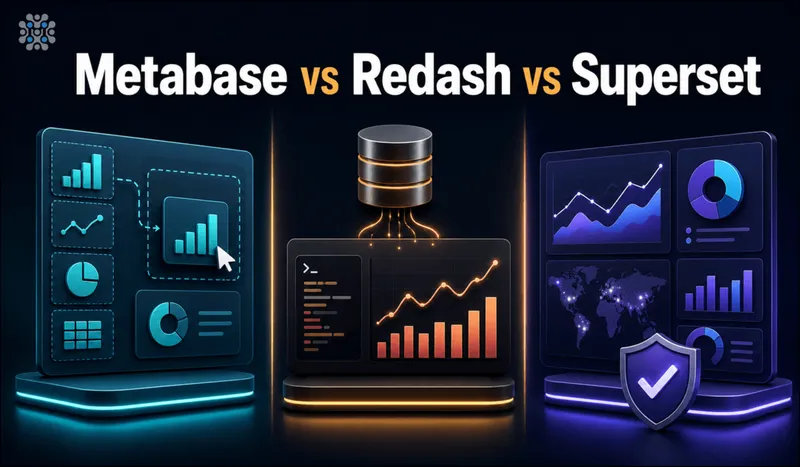
"Metabase vs Redash vs Superset" is a fair question because all three are legitimate, and we deploy all three, so nothing here is riding on picking a winner. Each one optimizes for a different person: Metabase for someone who doesn't want to write SQL, Redash for someone who wants to write SQL fast, and Superset for someone building dashboards at real scale with dozens of chart types.
They overlap enough that "which one" is a real question, and different enough that the wrong pick shows up as friction within a month. Here's the honest breakdown, including where each one has a genuine gap.
Quick answer
Jump to a section
How to choose between Metabase, Redash, and Superset
Three questions cover most of it:
- Who's actually building the dashboards? If it's mostly non-technical staff, Metabase's visual query builder removes the SQL requirement entirely. If it's analysts and engineers, Redash and Superset both assume SQL comfort and reward it with more flexibility.
- Do you need SSO and row-level security for free? Superset includes SAML and LDAP at no cost. Metabase gates SAML-based SSO behind its paid Pro or Enterprise tier. Redash supports SSO in its free edition too.
- Does active development pace matter to you? Metabase and Superset both ship regularly. Redash has slowed to roughly one release a year since Databricks acquired it in 2020, it still works, but don't expect fast-moving new features.
2 Redash: fast SQL dashboards, slow development pace
Redash is BSD-2-Clause licensed, permissively free, and built around writing a SQL query and turning it into a chart or dashboard fast. It connects to roughly 48 data sources, supports parameterized queries, scheduled alerts, and shareable dashboards. The honest caveat: Databricks acquired Redash in 2020, shut down its hosted cloud offering in 2021, and development has slowed to about one release a year since, version 26.3.0 landed in March 2026. It still works and is community-maintained by a small group of active contributors, just don't expect the feature pace of the other two.
Key features
- Fast SQL-to-chart workflow with parameterized queries
- Roughly 48 supported data sources
- Scheduled alerts and shareable dashboards built in
- Permissive BSD-2-Clause license, fully free to self-host
3 Apache Superset: the most chart types, free enterprise auth
Apache Superset is Apache 2.0 licensed, currently on the 6.x line (6.1.0, May 2026), and connects to 40+ databases including Snowflake, BigQuery, and Redshift. It ships more than 50 chart types, including geospatial visualizations most BI tools reserve for a paid tier, and includes SAML and LDAP authentication for free, no Enterprise upsell required. It expects SQL comfort from whoever owns the semantic layer, in exchange for the deepest dashboard and chart flexibility of the three.
Key features
- 50+ chart types including geospatial visualizations
- 40+ database connectors out of the box
- SAML and LDAP included free, not gated behind a paid tier
- Native cross-filtering and row-level security on dashboards
Metabase vs Redash vs Superset: feature comparison
| Feature | Metabase | Redash | Superset |
|---|---|---|---|
| License | AGPL v3 (core) | BSD-2-Clause | Apache 2.0 |
| Query approach | Visual, no-SQL builder | SQL-first | SQL-first |
| Chart types | Core set, clean UI | Standard set | 50+, including geospatial |
| SAML SSO | Paid Pro/Enterprise | Included free | Included free |
| Row-level security | Paid Pro/Enterprise | Limited | Included free |
| Development pace | Active | Slow, ~1 release/year | Active |
| Best for | Non-technical dashboard builders | Fast SQL-to-dashboard workflows | Scale and chart depth |
Why we deploy all three
We don't push clients toward one of these by default, because the right pick genuinely depends on who's going to open the tool every day. A marketing team that needs to self-serve reports without learning SQL gets Metabase. A data team that already lives in SQL and wants dashboards fast gets Redash or Superset, and the choice between those two usually comes down to whether free SAML matters and how many chart types the use case actually needs. All three ship as ready-to-launch AWS AMIs from us, so deployment friction isn't part of the decision.
Our dev guides cover each one in full: Metabase, Redash, and Superset. Prefer Google Cloud? The Metabase and Redash GCP Marketplace listings deploy the same stack inside your own GCP project. If you want the broader BI landscape including proprietary tools, our guide to choosing the right BI tool covers that wider comparison.
Where I'd start
Non-technical team, need self-serve dashboards without SQL: Metabase. SQL-comfortable team that wants a fast, stable workflow over frequent new features: Redash, as long as the slower release pace doesn't bother you. Need the deepest chart library and free enterprise auth at scale: Superset.
All three are real, production-grade tools we'd hand to a client without hesitation. The wrong move isn't picking any of them, it's picking based on a feature list instead of who's actually going to use it every day.
Frequently Asked Questions
Metabase vs Redash vs Superset: which should I pick?
Metabase if your team needs a visual, no-SQL query builder for non-technical users. Redash if you want fast SQL-driven dashboards and alerts, though it's in slow maintenance mode since Databricks acquired it. Superset if you need the most chart types and free SAML/LDAP at real scale.
Superset vs Metabase: what's the real difference?
Metabase leads with a point-and-click query builder that non-technical users can drive without SQL. Superset assumes SQL comfort but repays it with 50+ chart types and free enterprise-grade authentication (SAML, LDAP) that Metabase gates behind its paid Enterprise tier.
Is there a good Redash alternative that's more actively developed?
Superset and Metabase both ship releases more frequently than Redash, which has slowed to roughly one release a year since its 2020 Databricks acquisition. If active development pace matters to you, either is a safer long-term bet.
What's a fair open source BI tools comparison for a non-technical team?
Metabase, specifically because of its visual query builder. Redash and Superset both expect someone comfortable writing SQL to get real value, Metabase is built for the person who isn't.
Is Redash still maintained in 2026?
Yes, but slowly. Databricks acquired Redash in 2020 and shut down its hosted cloud service in 2021. The open source project is still community-maintained with releases roughly once a year, version 26.3.0 landed in March 2026, but it's not moving at the pace of Metabase or Superset.
Do Metabase, Redash, and Superset all support SSO?
Superset includes SAML and LDAP for free. Metabase supports SSO too, but SAML-based SSO specifically requires the paid Pro or Enterprise tier. Redash supports SSO and access control in its free, self-hosted edition.
Launch Metabase on AWS in Minutes
Launch a pre-configured Metabase server on AWS, ready for non-technical teams to build their own dashboards without writing SQL.
Get Metabase on AWS Marketplace