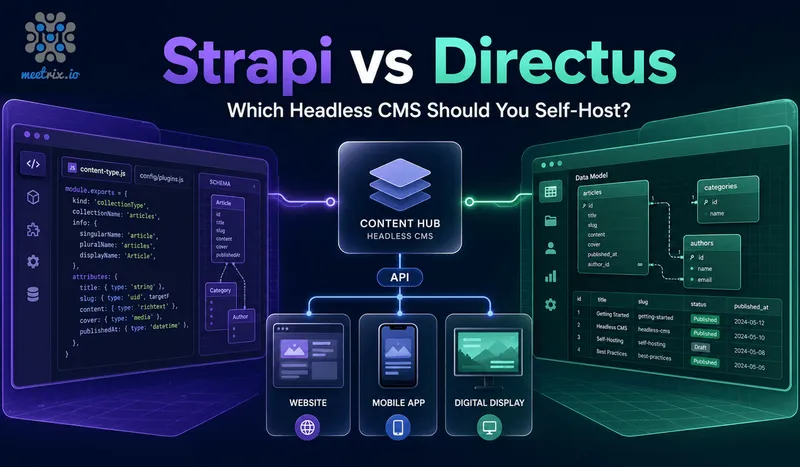
We package both of these as AWS AMIs, so read this as a genuine comparison, not a pitch for either. Strapi vs Directus looks like a coin flip on most feature-list comparisons, and for the core job, a REST and GraphQL API in front of your content, it mostly is. Where they actually diverge is licensing and architecture, and most reviews gloss over both.
Quick answer
Jump to a section
Strapi: code-first, unconditionally open
Strapi's Community Edition is MIT licensed with no revenue or company-size condition attached, self-host it free at any scale. It's built 100% in JavaScript and TypeScript, and version 5 improved the TypeScript experience and added a document service API. You define your content types inside Strapi, and it manages the underlying schema for you, a code-first approach that suits teams building a data model from a blank slate. Paid tiers exist for self-hosted deployments too: Growth runs around $15 per month per project and adds SSO and review workflows, Enterprise is custom quoted and adds audit logs and SLA support, but neither is required to run the core CMS.
Key facts
- MIT licensed, free to self-host with no revenue cap
- Code-first: define content types in Strapi, it owns the schema
- 100% JavaScript/TypeScript, REST and GraphQL APIs
- Growth tier (self-hosted, ~$15/month/project) adds SSO and review workflows
Directus: database-first, an API layer on what you already have
Directus takes the opposite architectural bet: point it at an existing SQL database (Postgres, MySQL, and others) and it instantly generates a REST and GraphQL API plus an admin app around your existing tables, without dictating or owning the schema. That makes it a natural fit for teams with a database that already exists and needs an API and content-editing UI added on top, rather than a greenfield content model. It's licensed under MSCL-1.0-GPL (its v12 license, replacing the earlier Business Source License 1.1), not a fully permissive license: self-hosting is free for organizations earning under $5 million a year in revenue and under 50 employees, and each release converts to GPLv3 four years after it ships.
Key facts
- Database-first: wraps an existing SQL database with an API and admin UI
- MSCL-1.0-GPL licensed (Directus's v12 license), free to self-host only under $5M annual revenue and under 50 employees
- Each release converts to GPLv3 four years after publication
- Cloud hosting available (Standard from ~$25/month) as an alternative to self-hosting
The licensing difference nobody mentions
Most Strapi vs Directus comparisons call both "open source" and leave it there, which flattens a real difference. Strapi's Community Edition is MIT licensed, full stop, no condition based on how much money your company makes. Directus is licensed under MSCL-1.0-GPL (its v12 license, replacing the earlier BSL 1.1), a source-available license, not an OSI-approved open source license, that's free for self-hosted use only while your organization stays under $5 million in annual revenue and under 50 employees. Cross either threshold and continuing to self-host Directus requires purchasing a license, even though the code is publicly visible the whole time. It does convert to GPLv3 eventually, four years after each release, so old versions become fully open over time, but whatever version you're actually running today is still under the license's revenue and employee-count conditions until its own four-year clock runs out.
Code-first vs database-first
This is the decision that actually matters day to day, more than the license. If you're starting a new project with no existing database, Strapi's code-first content-type builder gives you a clean, opinionated starting point, you design the model inside Strapi and it handles migrations as you evolve it. If you already have a production database with real tables and relationships, Directus wrapping an API around what exists, without asking you to restructure anything, saves real migration work. Retrofitting a Strapi project onto an existing legacy schema is possible but fights the tool's assumptions; retrofitting Directus onto a blank-slate greenfield project works, but you lose some of the guided content-modeling experience Strapi provides.
Cost
Both start free for self-hosting, with the caveat that Directus's "free" has a revenue and employee-count ceiling Strapi's doesn't. Below $5M in revenue and 50 employees, both cost whatever your server costs. Above either threshold, Directus requires a purchased license to keep self-hosting legally, while Strapi's Community Edition remains free regardless of company size, you'd only pay if you specifically want Growth or Enterprise features like SSO or audit logging, not because of revenue.
Strapi vs Directus: the facts
| Criterion | Strapi | Directus |
|---|---|---|
| License | MIT (Community Edition) | MSCL-1.0-GPL |
| Free self-hosting condition | None, any company size | Under $5M annual revenue and under 50 employees |
| Architecture | Code-first, Strapi owns the schema | Database-first, wraps your existing schema |
| Language / stack | 100% JavaScript/TypeScript | Node.js, works with your existing SQL database |
| API types | REST and GraphQL | REST and GraphQL |
| Self-hosted paid tier | Growth: ~$15/month/project | Custom quoted Enterprise self-hosted licensing |
| Best fit | New projects, greenfield content models | Existing databases needing an API and admin UI |
Where each one falls short
Strapi
- Retrofitting onto an existing, unrelated database schema fights the tool's code-first assumptions
- Some Enterprise-only features (advanced audit logs, deeper governance) require a custom quote
- JavaScript/TypeScript-only, no alternative language runtime if that doesn't match your stack
Directus
- Self-hosting isn't free above $5M in company revenue or 50 employees, a real cost most "open source" claims don't mention
- MSCL-1.0-GPL is source-available, not an OSI-approved open source license, worth knowing before you commit
- Smaller plugin and extension ecosystem than Strapi's longer-running community marketplace
Strapi vs Directus comes down to two separate questions that most comparisons collapse into one. Architecturally: are you modeling content from scratch, or wrapping an API around a database that already exists? Legally: does your organization's revenue matter to whether self-hosting stays free? Strapi answers "always free" regardless of the second question. Directus doesn't, and that's worth knowing before you build a project around it.
Our Strapi developer guide and Strapi install guide cover the self-hosted setup end to end, and our Directus developer guide, Directus AWS deployment guide, and Directus GCP Marketplace listing cover the same for Directus. If your project is closer to a blog or newsletter than a structured content API, our Ghost developer guide is worth a look too.
Frequently Asked Questions
Strapi vs Directus: which should I pick for a self-hosted project?
Strapi if you're building content types from scratch and want unconditional MIT licensing regardless of your company's revenue. Directus if you already have a SQL database and want an instant API and admin UI wrapped around it, and your organization earns under $5M a year and has under 50 employees (its self-hosted license is free only below both thresholds).
Directus vs Strapi: what's the core architectural difference?
Strapi is code-first: you define content types in Strapi and it manages the schema for you. Directus is database-first: point it at an existing SQL database and it generates a REST and GraphQL API plus an admin app around your existing tables, without taking ownership of the schema.
Is Directus actually free to self-host?
Only if your organization earns under $5 million a year in revenue and has under 50 employees. Directus is licensed under MSCL-1.0-GPL (its v12 license, replacing the earlier Business Source License 1.1), which is free for most uses below those thresholds but requires a paid license above them. Each release converts to full GPLv3 four years after publication.
Is Strapi free to self-host at any company size?
Yes. Strapi's Community Edition is MIT licensed with no revenue or company-size restriction of any kind. Paid tiers exist (Growth and Enterprise) for features like SSO and audit logs, but the base self-hosted CMS has no BSL-style revenue cap.
What is a fair open source headless cms comparison summary?
Both are genuinely open source, but with different fine print. Strapi's MIT license is unconditional. Directus's license (MSCL-1.0-GPL) is conditional on revenue and company size for self-hosting, and converts to GPLv3 only after four years per release. Read the license before assuming 'open source' means the same thing for both.
Which has a bigger plugin or extension ecosystem?
Strapi, currently. Its marketplace of plugins and its larger, longer-running community produce more ready-made integrations. Directus extends primarily through its own extensions SDK and custom panels, which is powerful but has a smaller library of pre-built community extensions to pull from.
Launch Strapi on AWS in Minutes
Launch a pre-configured Strapi server on AWS, MIT licensed and free to self-host at any company size, ready to build your content API.
Get Strapi on AWS Marketplace