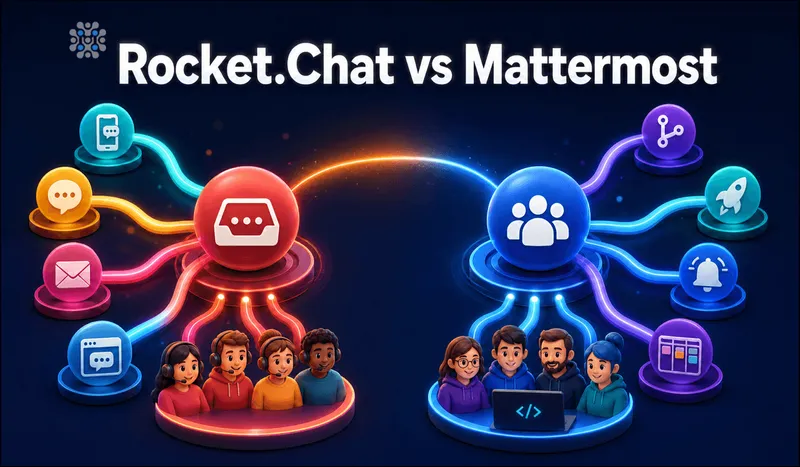
Meetrix packages both of these as AWS AMIs, so neither side of this comparison is a stranger to us, and neither gets a pass. Rocket.Chat vs Mattermost comes down to one real question once you strip out the marketing: do you need customer-facing omnichannel support routed into the same inbox as your team chat, or do you just need internal team chat? Rocket.Chat does both. Mattermost does the second one and does it well, but has no answer for the first.
Quick answer
Jump to a section
Rocket.Chat: team chat plus customer-facing omnichannel
Rocket.Chat's Community edition is MIT licensed, free to self-host, and includes unlimited users, channels, and messages. What sets it apart from a plain team chat tool is Omnichannel: WhatsApp, SMS, email, and web live chat conversations all route into the same agent inbox your internal team already uses. As of April 2026, Rocket.Chat retired its mid-tier Pro plan; the lineup now runs from the free self-hosted Community edition straight to custom-quoted Enterprise plans (Commercial, Government, Defense variants), with no published self-serve price in between.
Key facts
- MIT licensed, unlimited users on the self-hosted Community edition
- Omnichannel routing: WhatsApp, SMS, email, and live chat into one inbox
- Built-in video conferencing, two-factor authentication, and file sharing
- Enterprise adds HA clustering, audit logging, DLP, and AI features, custom quoted
Mattermost: internal team chat, nothing else bolted on
Mattermost's Team Edition is also MIT licensed, free to self-host for deployments under 250 users where single sign-on isn't required. It's built specifically around the software development lifecycle: channels, threads, voice calls, and integrations aimed at engineering and DevOps teams. There's no customer-facing channel layer here at all, Mattermost assumes the people in the workspace are your own employees, not external contacts routed in from WhatsApp or SMS.
Key facts
- MIT licensed Team Edition, free for deployments under 250 users, no SSO required
- Built-in voice calls, threaded discussions, and SDLC-focused integrations
- Professional tier: $10/user/month (annual), caps at 250 users
- Enterprise scales to 50,000 concurrent users, 200,000 on Enterprise Advanced
Omnichannel vs internal-only
This is the one criterion that actually decides most evaluations, everything else is closer than either vendor's marketing suggests. Rocket.Chat's Omnichannel module centralizes WhatsApp, SMS, email, and web live chat into a single agent view, with routing rules, business hours, and canned responses built in. It's a genuine customer-support surface, not a chat widget bolted onto a team tool.
Mattermost has nothing comparable, and it's not an oversight, it's a scope decision. Mattermost is built for people already on your payroll talking to each other, with integrations that assume a software team's workflow: Jira, GitLab, PagerDuty, CI/CD pipelines. If your actual need is routing customer WhatsApp messages to a support queue, Mattermost vs RocketChat isn't a close call, Rocket.Chat is the only one of the two that does it.
Cost
Both start at the same number: zero. Rocket.Chat's Community edition and Mattermost's Team Edition are each MIT licensed with no per-seat fee at self-hosted deployment, you pay for the server, nothing else. Mattermost's Professional tier is transparent about pricing, $10 per user per month billed annually, capped at 250 users. Rocket.Chat used to have a similar self-serve mid-tier at $8 per user per month, but that Pro plan was retired in April 2026; anything beyond the free Community edition now requires a custom Enterprise quote with no published number.
That difference matters if you're the kind of team that wants to scale gradually and pay incrementally. Mattermost gives you a clear next step at a known price. Rocket.Chat gives you free or a sales call, with nothing published in between.
Setup and the underlying stack
Rocket.Chat runs on Node.js with MongoDB as the database. Mattermost runs on a Go server backed by PostgreSQL or MySQL. Both are standard Docker Compose deployments for a small team, running in under an hour on either one. The difference shows up later: MongoDB replica sets for high availability are a different operational skill than PostgreSQL streaming replication, and if your team already runs one database engine in production, that existing expertise leans you toward whichever tool matches it.
Support and reliability
Neither vendor publishes a response-time SLA for their free self-hosted edition, that's standard for open source software; community forums are the support channel until you pay for something more. Mattermost's paid Enterprise tier commits to 24/7 support with a four-hour response time, plus an optional Premier Support add-on. Rocket.Chat's Enterprise plans include premium support as part of the custom-quoted package, but without a published response-time number to compare directly against Mattermost's four-hour commitment.
Scale
Mattermost publishes hard numbers: Enterprise scales to 50,000 concurrent users, and a newer Enterprise Advanced tier (aimed at defense and critical infrastructure customers) scales to 200,000. Rocket.Chat doesn't publish an equivalent concurrent-user ceiling for self-hosted Enterprise deployments; its scale story leans more on Omnichannel throughput (agent seats, contact volume) than raw concurrent chat users, which makes a direct number-for-number comparison hard to state honestly.
Rocket.Chat vs Mattermost: the facts
| Criterion | Rocket.Chat | Mattermost |
|---|---|---|
| License (free tier) | MIT (Community) | MIT (Team Edition) |
| User cap on free tier | None | None under 250 users, but SSO requires a paid tier |
| Omnichannel (WhatsApp/SMS/live chat) | Yes, built in | Not available |
| Self-serve paid tier | None published (Pro retired April 2026) | Professional: $10/user/month (annual) |
| Enterprise pricing | Custom quote only | Custom quote only |
| Underlying database | MongoDB | PostgreSQL or MySQL |
| Published concurrent-user ceiling | Not published | 50,000 (Enterprise), 200,000 (Enterprise Advanced) |
| Built-in video calls | Yes | Yes |
| SDLC-focused integrations | Available, less central to the product | Core focus of the product |
Switching between them
Both store their data in an open, documented database rather than a proprietary format, so nothing is technically locked away from you the way SaaS export limits can lock away Slack history. But there's no official Rocket.Chat-to-Mattermost import tool, or the reverse. Moving between them means writing your own export script against whichever database you're leaving, and mapping channels, users, and message history into the other tool's schema yourself. It's a real project, not a checkbox.
Where each one falls short
Rocket.Chat
- No published self-serve tier between free Community and custom-quoted Enterprise, since April 2026
- MongoDB replica set operations are a different skill set than most teams already running Postgres have
- No published concurrent-user ceiling makes scale planning harder to pin down in advance
- The Omnichannel feature set that justifies picking it over Mattermost goes unused if you never needed customer-facing channels in the first place
Mattermost
- No omnichannel layer at all, if customer support routing becomes a requirement later, it's not an upgrade path, it's a different tool
- SSO requires a paid tier even for teams that would otherwise stay on the free edition
- Professional caps at 250 users, forcing a jump straight to negotiated Enterprise pricing past that point
- Its integration ecosystem leans hard toward software teams; less natural fit for non-technical departments
Rocket.Chat vs Mattermost isn't a question of which is better built, both are mature, MIT licensed, and genuinely free to self-host at real scale. It comes down to whether Omnichannel is a feature you'll use or a feature you'll pay operational complexity for and never touch. Pick Rocket.Chat if customer-facing channels are part of the job. Pick Mattermost if they're not, and take the lighter Postgres-based stack instead.
Our Rocket.Chat developer guide and Rocket.Chat AWS setup guide cover the self-hosted install end to end, including Omnichannel configuration. If Mattermost fits your use case better, our Mattermost deployment guide covers that path in the same depth.
Frequently Asked Questions
Rocket.Chat vs Mattermost: which is the better self hosted Slack alternative?
Rocket.Chat if you need customer-facing omnichannel support (WhatsApp, SMS, live chat) alongside internal team chat. Mattermost if you only need internal team communication and want deeper SDLC-focused integrations. Both are MIT licensed and free to self-host with no user cap.
Mattermost vs RocketChat: which has more features for free?
Rocket.Chat's free Community edition includes omnichannel routing across WhatsApp, SMS, and web chat alongside internal messaging, unlimited users, and MIT licensing. Mattermost's free Team Edition focuses purely on internal team chat with no omnichannel layer at all.
Is Rocket.Chat self hosted actually free?
Yes. Anyone searching rocket chat self hosted wants to know if the free version is real, and it is: the Community edition is MIT licensed with unlimited users, channels, and messages, no license fee at self-hosted deployment. You pay for the server. Enterprise features like advanced omnichannel routing at scale, audit logging, and HA clustering require a paid, custom-quoted license.
Does Mattermost have omnichannel customer support like Rocket.Chat?
No. Mattermost is built for internal team chat, not customer-facing channels. If you need to route WhatsApp, SMS, or live chat conversations into the same inbox your team uses, Rocket.Chat is the only one of the two built for that.
Which is easier to run, Rocket.Chat or Mattermost?
Mattermost's stack (Go server, PostgreSQL or MySQL) is generally considered lighter to operate than Rocket.Chat's Node.js and MongoDB stack, particularly MongoDB replica set management once you're past a single-node setup. Neither is hard to run for a team that already manages a database in production.
Can I migrate from Rocket.Chat to Mattermost, or the other way around?
There's no official first-party import tool between the two. Both store messages in a documented, open database schema, so migration is technically possible with a custom export script, but it's a build-it-yourself project, not a supported feature on either side.
Launch Rocket.Chat on AWS in Minutes
Launch a pre-configured Rocket.Chat server on AWS with Omnichannel ready to configure, no MongoDB setup required from scratch.
Get Rocket.Chat on AWS Marketplace