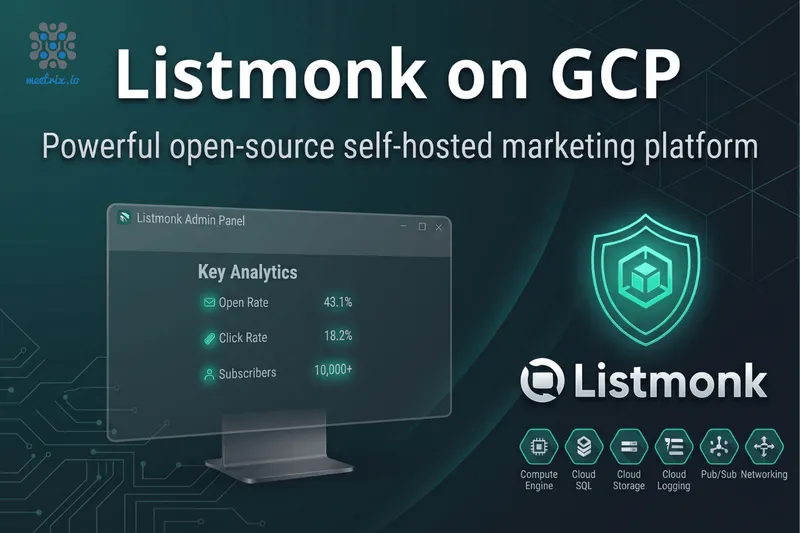
Your Newsletter, Your Server, Your Subscriber List
Most newsletter tools want your subscriber list on their servers, not yours. That is fine until they change pricing overnight, or your "free tier" subscriber cap gets hit halfway through a campaign, or you just do not like the idea of someone else owning your relationship with your own readers. None of that is a hypothetical - it happens to mailing list owners every year.
The Listmonk Newsletter Manager on GCP Marketplace by Meetrix sidesteps the whole problem. Listmonk is a fast, open-source mailing list and newsletter tool, and we packaged it so it launches ready to use on your own Google Cloud project. Your subscribers, your campaigns, your data - on infrastructure you actually control.
What is Listmonk?
Listmonk is an open-source, self-hosted newsletter and mailing list manager written in Go, with Postgres doing the heavy lifting underneath. It covers what you would expect from a paid SaaS tool - subscriber lists, segmentation, double opt-in, campaign templates, and click and open tracking - but you run it on your own server instead of handing your list to a third party.
It is built for people who send newsletters often enough to care about deliverability and analytics, but who do not want a monthly bill that scales with every new subscriber. Publishers, SaaS companies, newsletters with a paid tier, e-commerce stores - anyone sending recurring email to a list they actually own.
Why Owning Your List Actually Matters
How Deployment Works
Setting Listmonk up by hand means provisioning a Postgres database, configuring SMTP relay settings, and wiring up SSL before you can send a single campaign. Through the Marketplace, it is four steps:
- Launch from GCP Marketplace Open the Meetrix Listmonk listing, pick your region and machine size, and hit Deploy. Listmonk and its Postgres database come up already connected to each other.
- Point Your Domain Add an A record pointing your chosen subdomain (lists.yourdomain.com, for example) at the instance's external IP. This is what your admin panel and subscriber pages will run on.
- SSL Switches On, Then Connect Your SMTP The instance provisions a Let's Encrypt certificate automatically. From there, add your SMTP provider's credentials in the admin panel, whether that is your own mail server or a service like SES or Mailgun.
- Import Subscribers and Send Import your existing list (or start fresh with a public subscription page), build your first campaign in the editor, and send. You will see opens and clicks roll in from the dashboard.
What Meetrix Brings to This Deployment
- Postgres and Listmonk, Already Wired Together - The image ships with a tested database connection, correct GCP firewall rules, and automated SSL. You skip the part where you debug a connection string at midnight.
- No Guesswork on SMTP Setup - We document exactly how to connect your own mail server or a transactional provider, and what DKIM and SPF records to publish so your first campaign does not land in spam.
- People Who Have Actually Run Mailing Lists - If something is not sending or tracking right, you are talking to someone who understands campaign deliverability, not a support macro.
- It Stays in Your GCP Project - The server runs in whatever region you choose, inside your own account. Your subscriber list never sits on a vendor's shared infrastructure.
- No Per-Subscriber Pricing - Listmonk does not charge by list size. You pay GCP for compute and storage, whether you have 500 subscribers or 500,000.
Who Is Listmonk on GCP Right For?
If you send a newsletter occasionally and do not mind a free SaaS tier, you probably do not need this. But it is a strong fit if you are:
- A publisher or independent writer tired of per-subscriber pricing eating into revenue
- A SaaS company sending product updates to a list that keeps growing
- An e-commerce store that wants campaign data without sharing it with a third party
- A paid newsletter operator who needs full control over subscriber records
- A privacy-conscious team that does not want subscriber emails sitting on someone else's servers
- Anyone who has hit a SaaS provider's subscriber cap mid-campaign and does not want it to happen again
Listmonk on GCP by Meetrix vs Alternatives
| Feature | Listmonk on GCP by Meetrix | Mailchimp | Sendy | Self-Hosted Listmonk (Manual) |
|---|---|---|---|---|
| Hosting | Your GCP account, fully self-hosted | Mailchimp's cloud | Your own server, license required | Your GCP VM, set up by you |
| Subscriber Data Control | Total - your list never leaves your project | Mailchimp holds your subscriber data | Total, on your own infrastructure | Total, if you got the config right |
| Deployment Time | Minutes via GCP Marketplace | Minutes, but locked into their platform | Hours, plus a one-time license fee | Hours, more if Postgres trips you up |
| SSL & Email Auth | Automated, plus DKIM/SPF guidance included | Handled by Mailchimp | Manual - your responsibility | Manual - easy to get wrong |
| Pricing Model | Just GCP compute costs - no per-subscriber fee | Scales up sharply with list size | One-time license, plus your own SMTP costs | Just GCP compute costs |
| GDPR / Data Residency | Pick your GCP region, data stays put | Mailchimp's data processing terms apply | Depends how you host it | On you to configure correctly |
| Support | Meetrix infrastructure engineers, 24/7 | Mailchimp support tiers | Community forums, paid tickets for bugs | Community forums, or you fix it yourself |
Resources
Quick Setup Walkthrough
How Teams Use This in Production
Cutting a SaaS Newsletter Bill That Kept Climbing
The problem
An independent publisher with 80,000 subscribers watched their monthly newsletter bill creep up every time their list grew. They liked their existing workflow and did not want to relearn a new tool, just stop paying per subscriber.
What we did
We deployed Listmonk on GCP, migrated their subscriber list and segments, and connected it to their existing transactional email provider so deliverability carried over cleanly from day one.
"Our bill went up every single month just because we were growing. Meetrix moved us to something we own, and now growth does not cost us anything extra." Editor-in-Chief, Independent Publication, United States
Keeping Customer Emails Off a Third-Party Marketing Platform
The problem
A B2B SaaS company's security team flagged that customer emails were sitting in a marketing platform's database with no clear data processing agreement that satisfied their enterprise clients' procurement requirements.
What we did
We deployed Listmonk inside their own GCP project, set it up alongside their existing transactional infrastructure, and documented the data flow for their next security review.
"Enterprise customers ask where their data lives now. With Listmonk on our own GCP project, we finally have a one-line answer instead of a paragraph of caveats." Head of Security, B2B SaaS, Sweden
Sending More Campaigns Without the Bill Following
The problem
A growing online store wanted to email customers more often - restock alerts, seasonal sales, abandoned cart follow-ups - but their old plan charged per email sent, which made frequent campaigns expensive fast.
What we did
We deployed Listmonk on a right-sized GCP instance, connected it to their transactional SMTP provider, and set up segmented lists so restock alerts and sales went only to the customers who cared about them.
"We used to think twice before sending an extra campaign because of the cost. Now we just send it. That alone changed how we talk to customers." Marketing Lead, Online Retailer, Indonesia
Frequently Asked Questions
What is Listmonk and how is it different from Mailchimp or Sendy?
Listmonk is an open-source newsletter and mailing list manager you run yourself, instead of renting space on someone else's platform. It handles subscriber lists, campaigns, double opt-in, and click and open tracking, the same things Mailchimp does. The difference is where your subscriber data lives. With Listmonk, it stays on your own server, not on a third party's database.
Do I need my own SMTP setup to send campaigns with Listmonk?
Yes, Listmonk does not send email on its own - it hands campaigns off to an SMTP provider you configure, whether that is your own mail server or a transactional service like SES, Mailgun, or Postmark. This is actually a good thing for deliverability, because you control your sending reputation directly instead of sharing an IP pool with strangers.
Will my newsletters actually land in inboxes instead of spam?
That depends on your SMTP provider and your domain's DKIM, SPF, and DMARC records, not on Listmonk itself. We set up DKIM signing on the deployment and give you the SPF and DMARC records to publish in DNS. From there, sending consistent campaigns that people actually open is what builds your reputation over time.
Can Listmonk handle a large subscriber list and multiple newsletters?
Yes. Listmonk runs on Postgres under the hood, which handles subscriber lists well into the hundreds of thousands without breaking a sweat. You can run as many lists and campaigns as you want from one instance - the only real constraint is the GCP machine size you pick, and you can resize that as you grow.
Get Your Listmonk Server Running on GCP
Stop renting your subscriber list from a SaaS platform. Deploy Listmonk on Google Cloud in minutes, set up by people who actually run mailing lists for a living.
Deploy on GCP Marketplace