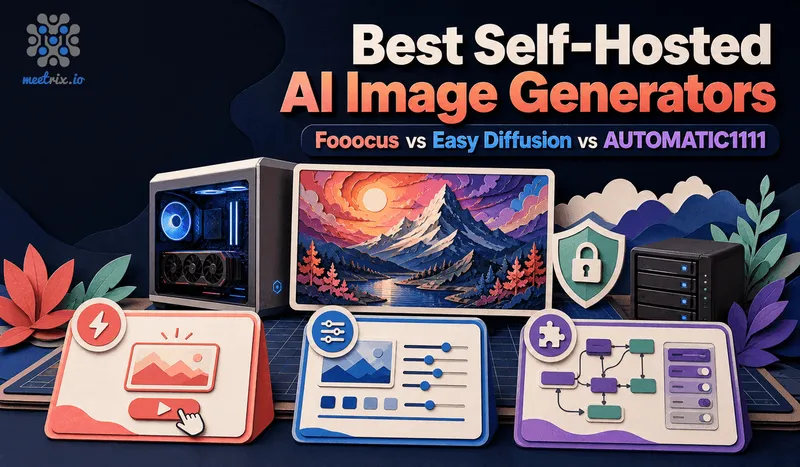
We package Fooocus as an AWS AMI with a hosted API, so weigh that against everything below. The best self hosted AI image generator depends on what you're optimizing for: fewest clicks to a good result, deepest customization, or the simplest possible install. Fooocus, AUTOMATIC1111, and Easy Diffusion are the three self hosted stable diffusion ui options that actually matter in 2026, and one of them has a maintenance problem most comparisons don't mention.
Quick answer
Jump to a section
How to choose a self hosted AI image generator
Three questions cover most of it:
- Do you want to tweak parameters, or just type a prompt? AUTOMATIC1111 exposes everything, samplers, CFG scale, step count. Fooocus hides most of that and optimizes it for you automatically.
- Do you need an API for automation, or just a UI for yourself? Fooocus is the one we've packaged with a working API, useful if you want to generate images programmatically rather than clicking through a browser each time.
- Are you running this locally or on a cloud GPU? All three work either way, but if your own machine doesn't have the VRAM, a stable diffusion cloud deployment on a GPU instance is the realistic path, and that's where a ready-made AMI saves the most setup time.
1. Fooocus: prompt-only simplicity, API included
Fooocus is GPLv3 licensed and built on a mix of AUTOMATIC1111 and ComfyUI's codebases, but the interface strips nearly all of that complexity away. The design goal, in the project's own words, is manual tweaking not needed, focus on the prompts and images, with the number of clicks between opening the app and generating a first image kept under three. We package it as an AWS AMI with a hosted API included, so it's also the one of the three built for automation, not just interactive browser use.
Key features
- Prompt-only workflow, automatic optimization of the parameters AUTOMATIC1111 exposes manually
- GPLv3 licensed, built on AUTOMATIC1111 and ComfyUI foundations
- Hosted API included in the Meetrix AMI, for automated or programmatic generation
- Actively maintained, unlike one of the other two tools on this list
2. AUTOMATIC1111: the most powerful, and the most stalled
AUTOMATIC1111's Stable Diffusion WebUI is AGPL-3.0 licensed and, by GitHub star count (over 164,000), the most popular Stable Diffusion interface ever built. It exposes every parameter, samplers, CFG scale, step count, and has the largest extension ecosystem of any tool on this list, built up over years as the default choice for tutorials and guides. The honest problem: its last major release shipped in mid-2024, with only a minor 1.10.1 update in February 2025, and through 2026 the project has seen maintenance patches only, no new-architecture support. It can't run Flux.1, the current quality leader among open image models.
Key features
- Every Stable Diffusion parameter exposed and adjustable
- The largest extension and plugin ecosystem of any Stable Diffusion UI
- The most tutorial and community documentation coverage anywhere
- No major release since mid-2024, no support for newer model architectures like Flux.1
3. Easy Diffusion: a true one-click install, MIT licensed
Easy Diffusion is MIT licensed, the most permissively licensed of the three, and its entire pitch is the install experience: a one-click setup that installs Stable Diffusion and its own web UI together, with no separate Python environment or dependency wrangling required. The interface is deliberately clutter-free, aimed at someone who has never run a command-line AI tool before. It doesn't try to match AUTOMATIC1111's extension depth or Fooocus's API-first design, it optimizes purely for getting a beginner from zero to a generated image with the least friction possible.
Key features
- MIT licensed, true one-click install with no separate environment setup
- Clutter-free UI aimed specifically at non-technical users
- Runs on your own PC without cloud GPU costs, if your hardware supports it
- Smaller extension ecosystem than AUTOMATIC1111, by design
The maintenance gap nobody mentions
Most "best AI image generator" roundups treat AUTOMATIC1111 as the default safe choice because of its star count and tutorial coverage, and that reputation is earned, it built the ecosystem the other two tools still borrow from. But a project's popularity and its development pace are different things. AUTOMATIC1111 hasn't shipped a major release since mid-2024, and the gap shows up concretely: it can't run Flux.1 or other newer model architectures that Fooocus and other actively developed tools already support. If you're picking a tool specifically to stay current with new model releases, that's worth knowing before you standardize on it.
Fooocus vs AUTOMATIC1111 vs Easy Diffusion: feature comparison
| Feature | Fooocus | AUTOMATIC1111 | Easy Diffusion |
|---|---|---|---|
| License | GPLv3 | AGPL-3.0 | MIT |
| Interface style | Prompt-only, automated tuning | Full manual parameter control | Simple, beginner-focused |
| Extension ecosystem | Small, growing | Largest of any Stable Diffusion UI | Small, by design |
| Hosted API available | Yes, included in our AMI | Via extensions, not built in | Not a primary feature |
| Active development | Yes | No major release since mid-2024 | Yes |
| Newer model support (e.g. Flux.1) | Depends on build, actively updated | Not supported | Depends on build |
| Install complexity | Low, under 3 clicks to first image | Moderate, more configuration options to learn | Lowest, true 1-click install |
Why we run Fooocus with a hosted API
Most teams that come to us wanting Stable Diffusion aren't trying to become power users of every sampler setting, they want good images generated reliably, often as part of an automated pipeline rather than a person clicking through a browser each time. Fooocus's prompt-only design already removes the tuning most people don't want to learn, and packaging it with a working API meant we could hand clients something that plugs into their own product instead of just a personal desktop app. It also helps that Fooocus is still actively maintained, unlike the tool with the largest install base on this list.
Our Fooocus developer guide covers the full setup, and AWS and GCP installation guides cover both cloud platforms. Our Fooocus API configuration guide is the one to read if automation, not a browser UI, is the actual goal.
Where I'd start
Want good images with the least effort, or need an API for automation: Fooocus. Need a specific extension from the largest ecosystem available and don't need the newest model architectures: AUTOMATIC1111, with eyes open about its stalled release cycle. Never touched Stable Diffusion before and want it running on your own PC today: Easy Diffusion.
All three are a genuinely open source ai image generator, free to run and modify. The real decision isn't licensing, it's how much friction you're willing to trade for how much control.
Frequently Asked Questions
What is the best self hosted AI image generator in 2026?
Fooocus for the fastest path from install to a good image, no parameter tweaking required. AUTOMATIC1111 if you want the deepest extension ecosystem and don't mind that development has largely stalled since early 2025. Easy Diffusion if you want the simplest possible 1-click install with no technical setup at all.
Fooocus vs AUTOMATIC1111: what's the real difference?
AUTOMATIC1111 exposes every Stable Diffusion parameter and has by far the largest extension library, but it's AGPL-3.0 and hasn't shipped a major release since early 2025, so it can't run newer architectures like Flux.1. Fooocus, GPLv3 licensed, hides that complexity behind a prompt-only interface aimed at getting a good result in under three clicks.
Easy Diffusion vs Fooocus: which is easier for a beginner?
Both are built for simplicity, but they solve different problems. Easy Diffusion (MIT licensed) focuses on the easiest possible one-click install on your own PC. Fooocus focuses on removing prompt and parameter complexity once you're already generating images, and it's the one we package with a hosted API on AWS.
Is there a good stable diffusion cloud option instead of running it locally?
Yes. Fooocus, AUTOMATIC1111, and Easy Diffusion can all run on a cloud GPU instance instead of your own machine, useful if your laptop doesn't have the VRAM for Stable Diffusion. We package Fooocus as a ready-to-launch AWS AMI with an API included, specifically for that use case.
Is AUTOMATIC1111 still worth using in 2026?
For its extension ecosystem and tutorial coverage, yes, it's still the most-documented option anywhere. For running current-generation models, less so: the project has seen only minor maintenance since its last major release in early 2025, and newer architectures like Flux.1 aren't supported.
Which of these three is open source with the fewest license restrictions?
Easy Diffusion is MIT licensed, the most permissive of the three. Fooocus and AUTOMATIC1111 are both GPL-family licenses (GPLv3 and AGPL-3.0 respectively), which are still open source but carry more conditions around distributing modified versions.
Launch Fooocus with a Hosted API on AWS
Launch a pre-configured Fooocus server on AWS with the API already set up, ready to generate images without tuning parameters or managing GPU drivers yourself.
Get Fooocus 2.0 on AWS Marketplace