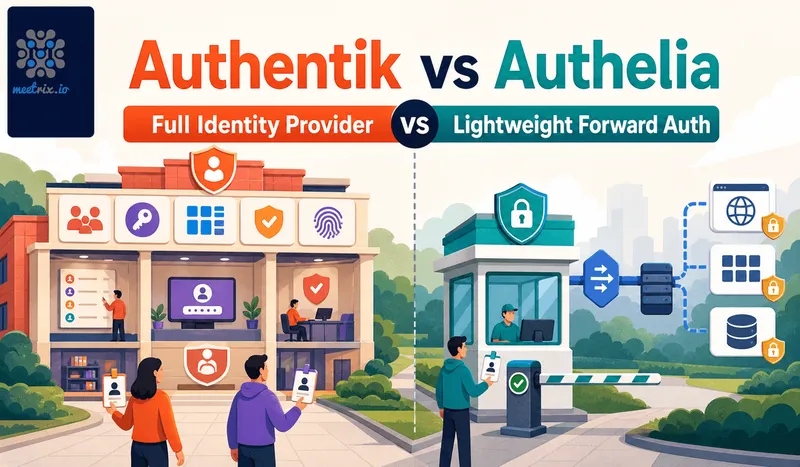
Authentik vs Authelia gets framed as a head-to-head more often than it should be. Authentik is a full identity provider: its own admin UI, user database, and support for OIDC, SAML, LDAP, and RADIUS. Authelia is forward-auth middleware that sits in front of a reverse proxy and decides whether a request needs a login before it's allowed through. They overlap at the edges, but picking between them starts with recognizing they're not really built to do the same job.
Quick answer
Jump to a section
Authentik: a full identity provider with an admin UI
Authentik's core is MIT licensed and built around a visual, flow-based configuration system with a proper web admin console for managing users, groups, applications, and access policies. Authentik proxy authentication works through outposts, lightweight proxy instances that can put SSO in front of an application with no native login support of its own, without modifying that application. Protocol coverage is broad: OIDC (with dynamic client registration), SAML, LDAP, RADIUS, and SCIM. An Enterprise tier at $5/user/month adds features like Google Workspace integration, WS-Federation, and mTLS login, mostly aimed at larger organizations.
Key features
- Full web admin UI for managing users, groups, and applications
- Outpost-based proxy that adds SSO to apps with zero native login support
- Broad protocol support: OIDC, SAML, LDAP, RADIUS, SCIM
- Visual, flow-based configuration for custom login and MFA sequences
Authelia: forward-auth middleware, not a full IdP
Authelia is Apache 2.0 licensed with roughly 25,000 GitHub stars, and its entire design is built around one job: sitting in front of a reverse proxy (Traefik, Nginx, Caddy, HAProxy) and deciding whether a request gets through or needs to authenticate first. There's no admin web UI by design, configuration lives in YAML files, which keeps the attack surface small and, per its own track record, has meant fewer reported vulnerabilities than tools that ship a full admin console. Fine-grained access rules match on subdomain, user, group, request path, method, and network, with a one-factor or two-factor policy chosen per rule. Since version 4.37, Authelia also ships an OIDC provider that has passed OpenID Foundation conformance certification, though the project itself still labels it beta, single sign-out isn't implemented yet.
Key features
- Forward-auth middleware for Traefik, Nginx, Caddy, and HAProxy
- No admin UI, configuration via YAML, smaller attack surface
- WebAuthn (FIDO2, passkeys) and TOTP two-factor authentication
- Fine-grained access rules by subdomain, user, group, path, and network
- OIDC provider since v4.37, OpenID certified, still beta with some gaps
Why these are different categories of tool
This is the part worth being direct about. If your actual need is "give my team accounts and let them log into a dozen different self-hosted apps with one identity," Authentik is built for exactly that, and Authelia will feel like it's missing pieces because it was never trying to be that. If your actual need is "put a login wall in front of my Grafana, Portainer, and a few other dashboards that don't have their own auth," Authelia does that with less to run and less to secure, and Authentik will feel heavier than necessary. The "vs" framing makes sense for search intent, but the honest answer is closer to "which category of tool do you actually need," not "which one wins."
Resource footprint
Authelia's minimum stack is three containers: Authelia itself, Redis for session storage, and PostgreSQL or SQLite for persistent data. Authentik needs four or more: a server process, a background worker, PostgreSQL, and Redis, plus additional outpost containers for each app you're proxying, and runs roughly 1GB of RAM at idle. Neither is heavy by modern standards, but Authelia's footprint is noticeably lighter, which matters more on a small homelab server than it does on dedicated infrastructure.
Can you run both?
Yes, and some self-hosters do, for reasons that make sense once you see the category difference clearly. A common pattern: Authentik handles real identity, the apps that actually speak OIDC or SAML and need proper user accounts, while Authelia sits in front of the smaller dashboards and admin panels that have no login of their own and don't need a full identity record, just a login wall. It's not the default setup for most people, running one tool is simpler than running two, but it's a legitimate answer when your service list has both kinds of needs and you don't want to force everything through outposts just to gate a Portainer instance.
Authentik vs Authelia: feature comparison
| Feature | Authentik | Authelia |
|---|---|---|
| License | MIT (core) | Apache 2.0 |
| Category | Full identity provider | Forward-auth middleware |
| Admin web UI | Yes, full console | No, YAML configuration |
| Minimum stack | 4+ containers | 3 containers |
| SSO for apps with no native login | Yes, via outposts | Via reverse-proxy forward-auth |
| OIDC support | Comprehensive, dynamic client registration | Since v4.37, OpenID certified, still beta |
| SAML / LDAP / RADIUS | Yes | No |
| 2FA methods | Multiple, including WebAuthn | WebAuthn, TOTP |
Authentik vs Authelia isn't a contest either tool wins outright, they're built for adjacent but different jobs. Pick Authentik when you need a real identity provider with an admin UI and broad protocol support. Pick Authelia when a lightweight login wall in front of your reverse proxy is genuinely all you need, and you'd rather not run or secure a full admin console for that.
Our Authentik developer guide and single-click AWS setup guide cover the full identity provider path. If Authentik's protocol breadth feels like more than you need, our Keycloak developer guide covers the other full IdP we deploy, useful for comparison before you commit either way.
Frequently Asked Questions
Authentik vs Authelia: are they even solving the same problem?
Mostly not. Authentik is a full identity provider with its own admin UI, user database, and multi-protocol support. Authelia is forward-auth middleware that sits in front of a reverse proxy and decides whether a request needs a login first. They overlap at the edges, but Authelia isn't trying to be a drop-in Authentik replacement.
What is a good Authelia alternative with a full admin UI?
Authentik. Authelia has no web-based admin console by design, configuration is YAML files. If you want a UI for managing users, groups, and applications visually, Authentik is built for that; Authelia deliberately isn't.
What is a good lightweight sso self hosted option for a homelab?
Authelia, if you're already running a reverse proxy like Traefik, Nginx, or Caddy. It needs only three containers (Authelia, Redis, and Postgres or SQLite), versus Authentik's four-plus, and has no admin UI to secure or maintain.
Does Authelia support authentik proxy authentication style SSO for apps without native login support?
Not the same way. Authentik's outposts can add SSO in front of an app with zero built-in authentication support of its own. Authelia's forward-auth model does something similar at the reverse-proxy layer, but it's configured through proxy rules and YAML, not Authentik's outpost system specifically.
Can Authelia act as a full OIDC identity provider?
Since version 4.37, yes, in a limited form. Authelia's OIDC provider has passed OpenID Foundation conformance certification, but the project itself still labels it beta, and features like single sign-out aren't implemented yet. Authentik's OIDC support is more complete.
Which is more secure, Authentik or Authelia?
Authelia has historically reported fewer vulnerabilities, largely because it has a smaller attack surface: no admin UI, less code, and a single-purpose design. That's not a knock on Authentik's security, it's a natural consequence of Authentik doing more.
Launch Authentik on AWS in Minutes
Launch a pre-configured Authentik server on AWS, a full self-hosted identity provider with SSO already wired up.
Get Authentik on AWS Marketplace